A menopause sleep app that makes sense of your nights

TALIA is a private menopause sleep app and sleep diary for iPhone. Each morning you log how you slept in a tap or two, note what disrupted the night, and TALIA builds the pattern over time — alongside your symptoms, HRT and any other medications and supplements. So instead of trying to recall six weeks of broken sleep in a ten-minute appointment, you bring a clear record.
Everything stays on your phone. No account, no cloud, no wearable required.
Why perimenopause disrupts your sleep
Sleep is one of the most common and most talked-about symptoms of the menopause transition. It's also one of the most serious. Menopause specialist Dr Mary Claire Haver has described sleep disruption as one of the most significant and under-recognised health challenges facing women in midlife, estimating that nearly every woman she sees in perimenopause or early menopause has some degree of it, even when it isn't their main complaint. She links poor sleep not just to tiredness but to heart health, memory, concentration, mood and overall wellbeing — not something to be accepted as a normal part of ageing.
The Menopause Charity's guidance on sleep in menopause makes the same practical point TALIA is built around: a sleep diary helps you spot patterns.
How a sleep diary helps your doctor
You'd hope every midlife appointment included some version of "how are you sleeping?" But even when it does, memory is not a reliable instrument, and perimenopause makes it worse. Brain fog isn't a metaphor — it's a measurable dip in working memory, processing speed and recall. Asking you to reconstruct a month of sleep from memory is asking you to use the very thing the transition has compromised.
Your doctor needs to know whether your sleep is getting better or worse, whether there's a pattern to what causes it, and — if you're on HRT — whether it shifts after a dose change. Without a record, that detail is gone. And as the Sleep Foundation notes, the same symptoms can have more than one cause — thyroid problems, medication side effects and underlying sleep conditions can look identical to hormonal disruption, and sometimes sit alongside it. The more your doctor can see, the better placed they are to help. As Dr Gillian Goddard has pointed out in The Times, women's concerns are too often dismissed; her advice is practical — catalogue your symptoms, pinpoint when things changed, and be persistent.
What's actually happening at night
Sleep disruption in perimenopause isn't one thing. For some women it starts with not being able to fall asleep at all. For others the night begins fine and falls apart later.
The most common pattern is waking repeatedly — fragmented sleep rather than one long stretch awake. Eight hours in bed that feel like four.
Then there's early-morning waking, typically between 2am and 5am. It's different from ordinary insomnia: you fall asleep easily, but the second half of the night unravels. You wake alert, often anxious, and getting back to sleep is hard.
Night sweats are the most visible disruption, though not always the worst — you might wake drenched and get back to sleep easily, or be woken by heat and hot flushes. Add palpitations, needing the toilet two or three times, restless legs, and the anxiety that does its worst work between midnight and dawn, and the picture is rarely simple. Different patterns point to different things, which is exactly why seeing yours written down matters.
How TALIA's Sleep Patterns works
We wanted sleep logging to take seconds, not become another chore at the hardest time of day to keep one.
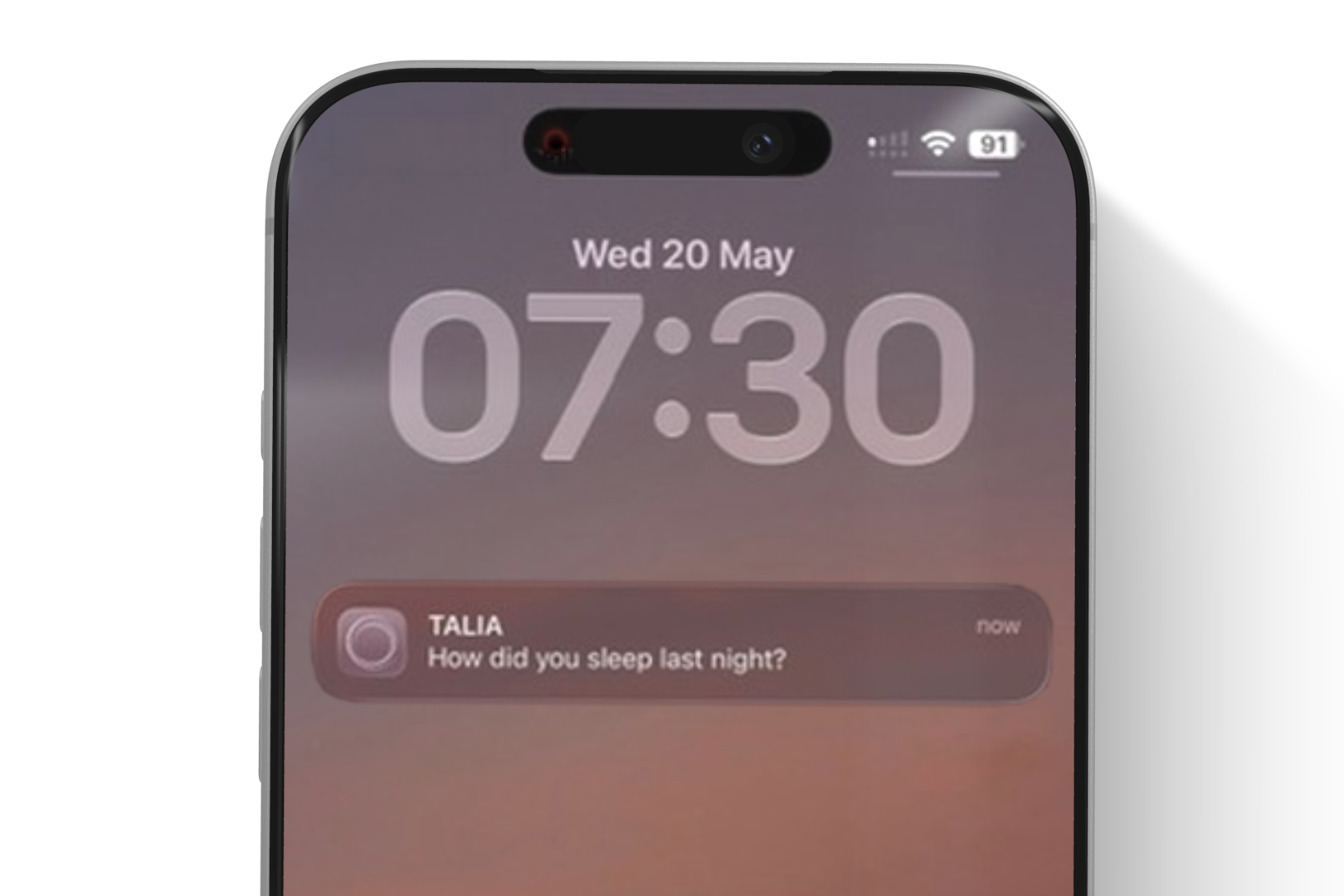
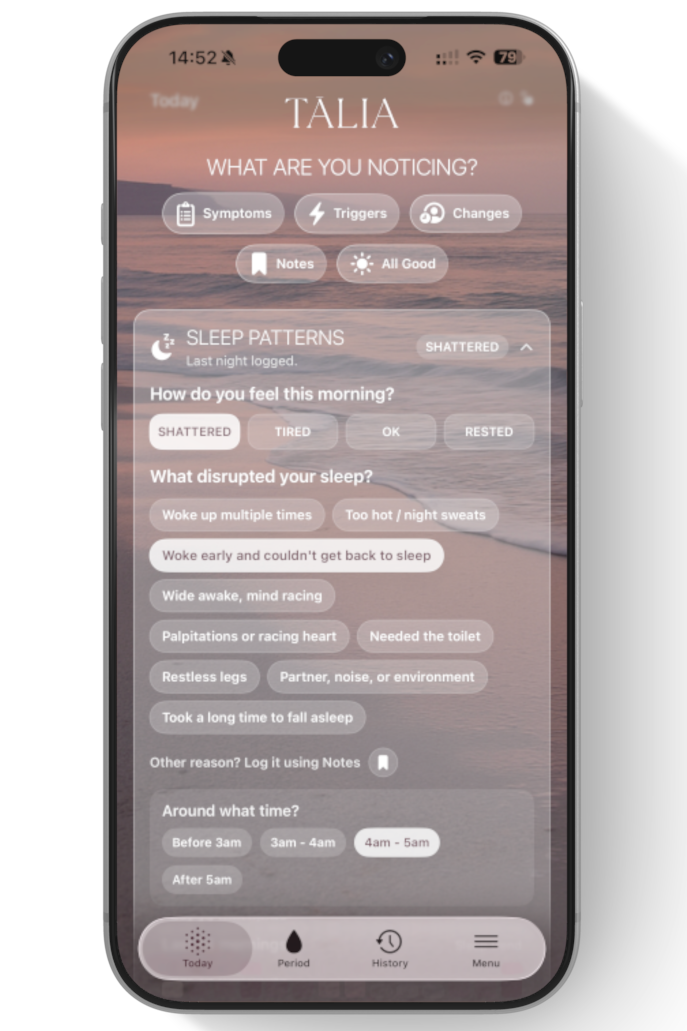
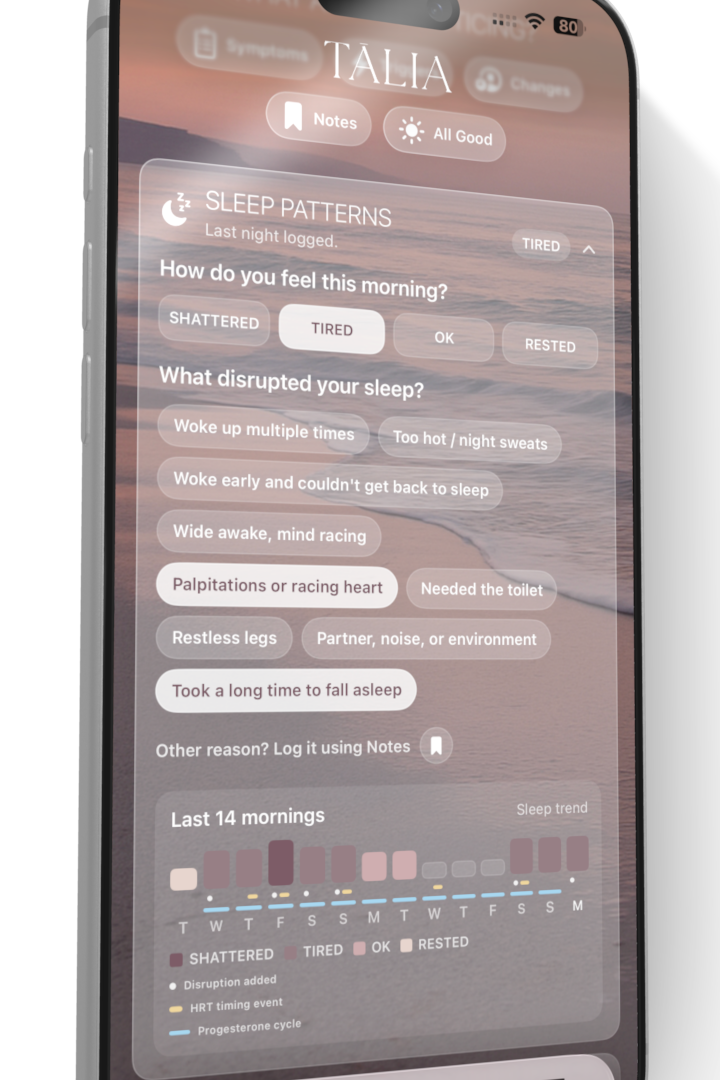
Each morning TALIA asks one question: how do you feel? Four answers — Shattered, Tired, OK, Rested. One tap.
If you choose Shattered or Tired, a second question appears: what disrupted your sleep? Pick any that apply:
- Took a long time to fall asleep
- Woke up multiple times
- Too hot, or night sweats
- Woke early and couldn't get back to sleep
- Wide awake, mind racing
- Palpitations or racing heart
- Needed the toilet
- Restless legs
- Partner, noise or environment
If you pick "woke early and couldn't get back to sleep", you can log when, in one more tap: before 3am, 3–4am, 4–5am, or after 5am. The timing of early waking carries specific meaning for a clinician, and "early waking, 3–4am, 18 of 30 nights" gives them something concrete to work with. On a good night, the whole thing is a single tap.
Why there's no wearable
We made a deliberate choice not to pull in data from watches or sleep sensors. TALIA is on-device and private by design, and that shapes every feature. What matters here isn't sleep-stage data from a sensor — it's whether your sleep is getting better or worse, what's disrupting it, and whether that connects to your menopause and treatment. That comes from you.
See your sleep next to your HRT
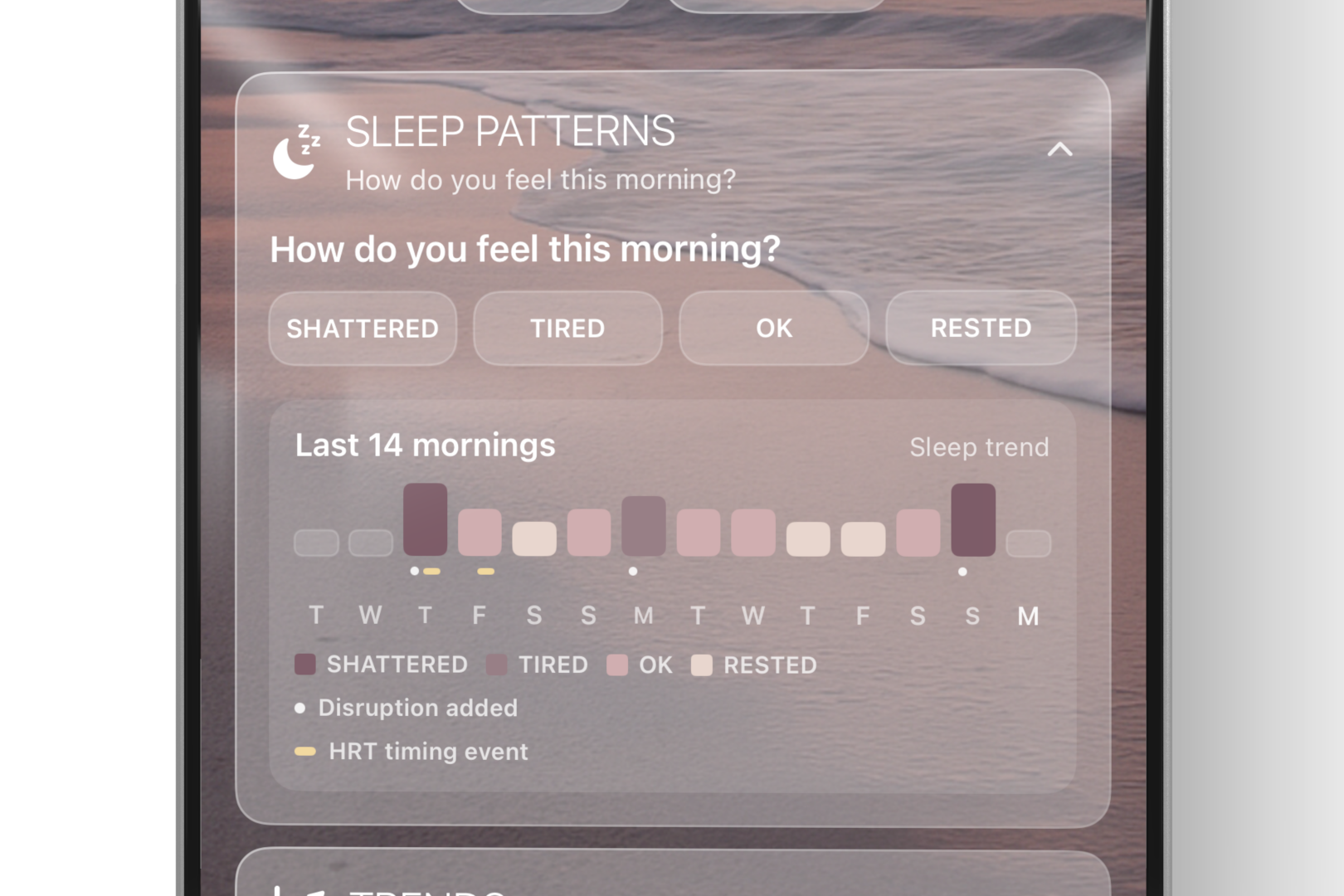
The 14-day view lays each morning out as a colour-coded strip, from Shattered through to Rested, with a small marker on the nights you logged a disruption. If you're on HRT, your dose changes are marked on the same line — and for cyclical progesterone, the cycle window is shown too, which is genuinely useful for a GP. Sleep and treatment sit side by side.
Over a few weeks, things surface that are invisible night to night: worst mornings clustering in the days before a patch change or at a particular point in the progesterone cycle, night sweats easing after a dose goes up, early waking that hasn't shifted and is worth raising. Not everyone who tracks sleep is on HRT, and the pattern is just as useful without it — sitting alongside your symptoms and any other medications or supplements you log. None of it is a diagnosis; it's your own logged data, laid out so you and your clinician can see it rather than reconstruct it from memory.
Private by design
Nightly patterns, physical symptoms, medication timing — this is some of the most personal data about you, and it shouldn't leave your phone without your say-so. Sleep Patterns follows the same model as everything else in TALIA: your data stays on your device, there's no account and no TALIA server holding it, and you decide what to share, with whom, and when.
Common questions about sleep tracking in TALIA
Does TALIA track my sleep automatically?
No. TALIA is a sleep diary, not a sensor. You log how you slept each morning in a tap or two. It doesn't connect to a watch or measure sleep stages or hours — what it captures is how your nights actually felt and what disrupted them, which is what you and your doctor can act on.
How does a sleep diary help at a doctor's appointment?
It replaces "I haven't been sleeping well" with a record — how many nights were disrupted, what disrupted them, when early waking happened, and how all of that sits next to your HRT. Memory is unreliable in perimenopause; a logged pattern isn't.
What does TALIA ask about my sleep?
One question each morning — Shattered, Tired, OK or Rested. If the night was poor, you can tag what disrupted it from nine common causes, and optionally log the timing of early-morning waking. On a good night it's a single tap.
Can I see my sleep next to my HRT?
Yes, if you're on HRT. The 14-day view shows your sleep as a colour-coded strip with your HRT dose changes marked on the same line — and for cyclical progesterone, it marks the cycle window too, which is genuinely useful for a GP. If you're not on HRT, the same view still shows your sleep against your symptoms and any other medications or supplements you log.
Does TALIA diagnose sleep problems?
No. TALIA is a record, not medical advice. It never diagnoses, and it never suggests or adjusts medication or supplements. It organises what you've logged so you and your clinician can make sense of it together.
Is my sleep data private?
Yes. Everything stays on your iPhone — no account, no TALIA servers, no third-party sharing. Optional backup runs through your own iCloud account.
Is TALIA available on Android?
Not yet. TALIA is available for iPhone.
Built for better conversations
with your doctor.
A structured, continuous record of symptoms and treatment - developed to show what’s happening, changing and working, over time.