Your doctor has ten minutes. What you bring into that room determines the outcome.
There is a particular kind of appointment that women navigating perimenopause know well. You have waited weeks to get it. You have been preparing what to say. There is a lot riding on it, because for many women, the last one did not go the way they needed.
When it does not go well again, the reasons are rarely simple. Appointments are short, often ten minutes. Menopause is complex, every woman experiences it differently with symptoms that can overlap with depression, thyroid conditions, burnout, and anxiety.
The evidence base on HRT has changed considerably over the last decade. GP training hasn’t always kept pace – a 2021 UK survey of 173 NHS GPs found 52% felt they lacked sufficient support or training to advise on menopause treatment and 77.5% said training needed to improve in medical school and GP training. It was noted that “Doctor’s appointments can be stressful experiences and even more so during the menopause when women are feeling anxious, depressed, forgetful, and generally overwhelmed by their symptoms.”
None of this means the appointment cannot move things forward. It means that the women who get the most from it tend to arrive with something the doctor can act on: a clear record of what has been happening, how long it has been going on, what has changed, and what they want to discuss.
Your doctor has ten minutes. This is what they need from you – and how TALIA helps you prepare.
What changes when you arrive with structured evidence
The TALIA Doctor’s Report was developed with NHS and private clinicians, built around what a doctor needs to make a decision in the time available. It turns what you have been tracking into a single structured document: symptom patterns over time, your full HRT and medication record, adherence data, before-and-after symptom counts around each dose change, a clinical timeline, and space for your own notes/questions.
It can be shared as a PDF before the appointment, printed or opened on your phone. It stays on your device until you choose to share it.
What it does depends on where you are in your perimenopause journey. The same report works differently at each stage.
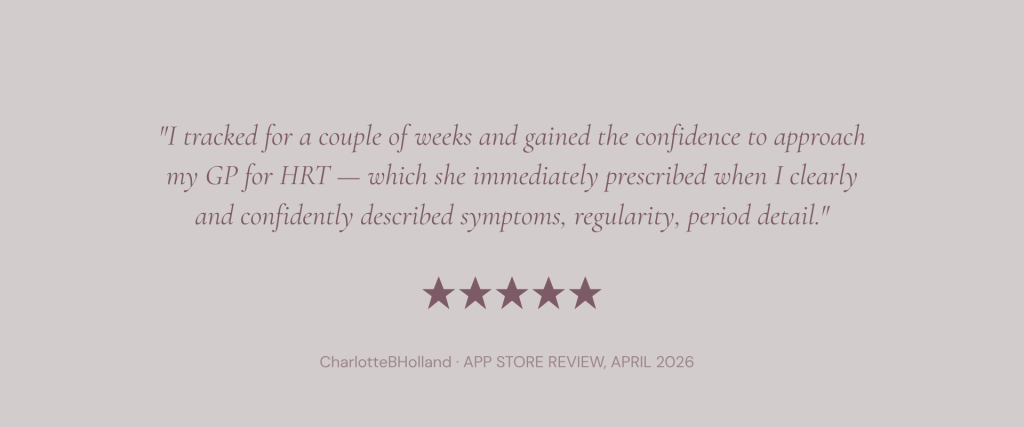
STAGE 1 – STILL GETTING ANSWERS
Building the case before diagnosis
If you are still trying to name what is happening, or you have named it but not yet been diagnosed, or been dismissed, offered antidepressants, or told your bloods are normal, the gap between what you are experiencing and what your doctor can see is at its widest.
NICE is the National Institute for Health and Care Excellence – the body that sets clinical guidelines for the NHS. Its guidelines are not suggestions; they are the standard of care that doctors in England are expected to follow. NICE NG23, updated in 2026, is clear that perimenopause in women over 45 is a clinical diagnosis made on symptoms. Blood tests are not recommended as a primary diagnostic tool because hormone levels fluctuate too significantly during this period to be reliably interpreted from a single result. In a ten-minute appointment without a structured symptom record, a doctor is working from a verbal account that you are trying to construct accurately, under pressure, while experiencing the cognitive symptoms that perimenopause causes.
A documented symptom history gives your doctor something to work with. There is a difference between ‘I have been feeling anxious and foggy’ and a structured record showing anxiety present on 58 of 80 logged days, brain fog on 44, palpitations on 65. Both are true. Only one is actionable.
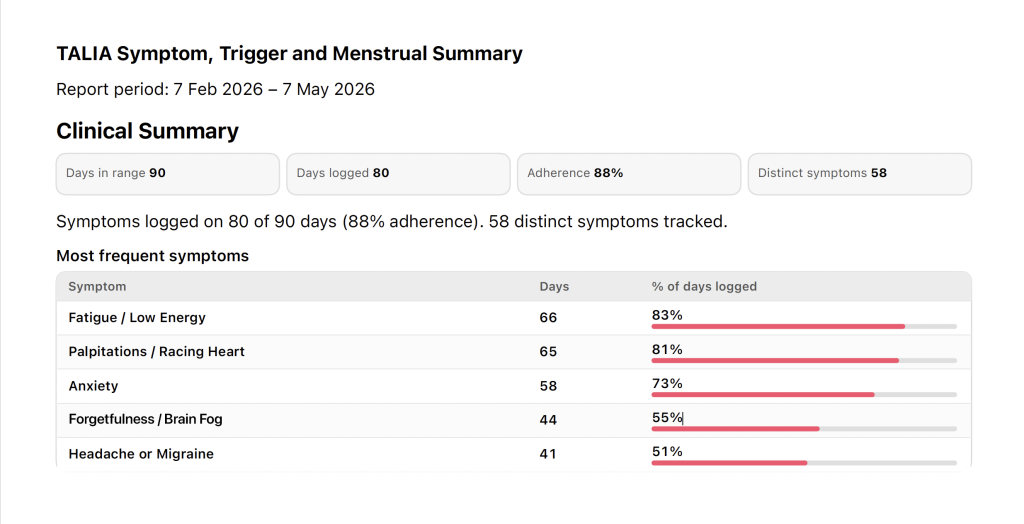
*Permission was given to share data from a TALIA User
The report includes your own questions and observations in your own words, flagged directly for sharing. For women who have been dismissed before, having those questions attached to a clinical record changes the dynamic of the conversation.
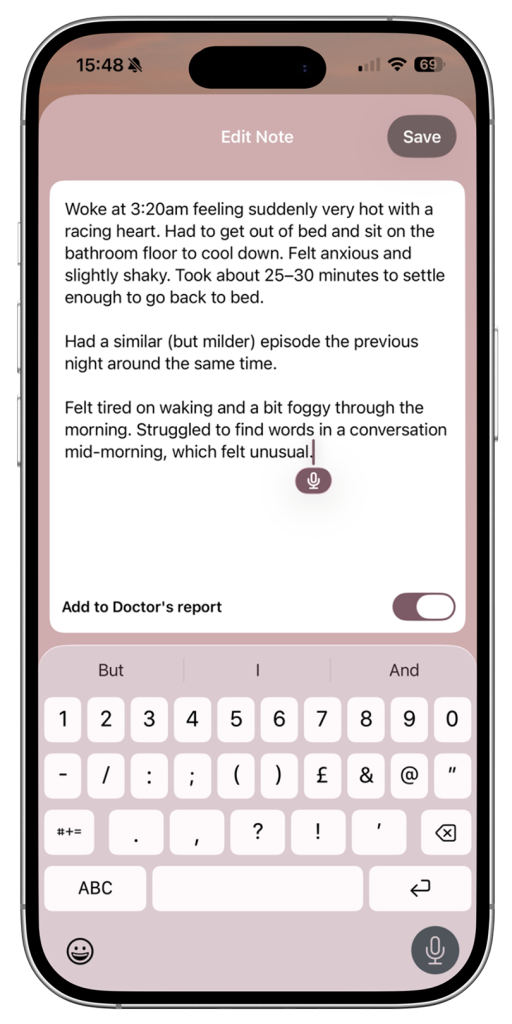
STAGE 2 – NEW TO HRT
Tracking whether it is working
HRT is a process. Most women titrate their treatment for months, adjusting doses, changing products, working out what combination helps. That process requires a way to see what each change actually did.
Without a record, the question ‘is my HRT working?’ gets answered by feeling, which is unreliable, and particularly so when brain fog and disrupted sleep are affecting your ability to assess your own state. With a structured log, it gets answered by evidence: what your symptom frequency was before a dose change, what it was in the weeks after, and whether the pattern shifted.
TALIA automatically calculates before-and-after symptom counts around each dose change. Your doctor can see whether a change helped and when, without asking you to remember. The adherence data in the report also separates two things that are easily confused: whether the treatment is not working, and whether the treatment has not been taken consistently.
That consistency is harder to maintain than it sounds. Brain fog makes it easy to lose track of whether you applied your gel this morning or yesterday. Progesterone cycles are easy to miscalculate when you are already managing everything else. TALIA’s reminders and supply tracking exist for exactly this reason: to hold the routine when your brain cannot. The report then shows your doctor what that routine actually looked like, so that when you are in the room together, you are both working from the same picture.
STAGE 3 – LONG TERM MANAGEMENT
Following the pattern as things change
Hormones continue to decline through and beyond menopause. Symptoms that have settled can return. A dose that worked well at six months may need reviewing at eighteen. Many women manage their treatment over years, not months.
For the woman five years into managing her HRT, the challenge is different from the one she faced at the beginning. She is not trying to name what is happening or establish whether treatment is working. She is trying to notice when things shift, brain fog returning after a stable period, sleep disrupting again, mood changing, before those changes become significant enough to affect her work or her relationships.
A record that builds over time makes those shifts visible in a way that day-to-day experience cannot. Something that changes gradually is often invisible until it has already changed considerably. A pattern view across weeks and months shows the direction of travel. When she goes back to her doctor, she is not starting the conversation from scratch
This is the layer of menopause management that almost no tool currently addresses. The woman who has been on HRT for three years and is coping is not the woman most likely to get a proactive appointment. She is the one most likely to notice something changing but not necessarily know when to act on it unless she can see the bigger picture herself.
Ten Minutes. Make them Count.
The evidence you bring into that room changes the outcome. Not because your doctor needs to be convinced to take you seriously, though for some women that battle is real, but because individualised care, as NICE now requires, needs individual data to work from.
Whatever stage you are at, still looking for answers, newly on HRT, or managing treatment over the long term, the Doctor’s Report turns what you have been tracking into something your doctor can act on. In the ten minutes you have.
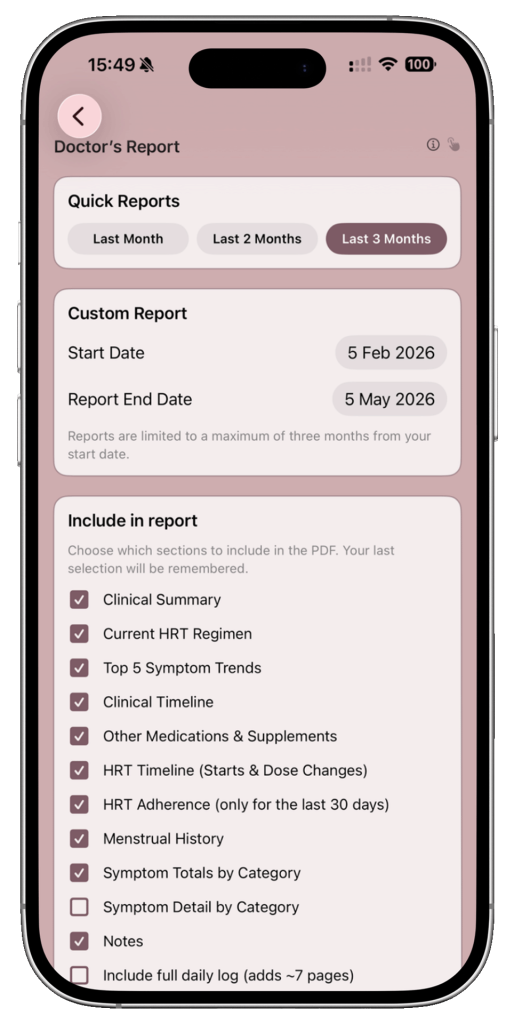
TALIA. Built for better conversations with your doctor.
See what the Doctor’s Report contains here.
14-day free trial . £3.99/month . Your data stays on your phone


Common questions about menopause appointments
How do I prepare for a menopause appointment?
Bring a clear record of your symptoms: what you have been experiencing, how long it has been going on, what has changed, and what you want to discuss. A structured symptom history, rather than trying to recall months of detail on the spot, gives your doctor something to act on in a ten-minute appointment. TALIA’s Doctor’s Report turns your tracked symptoms and HRT into a single document you can share.
Do I need a blood test to be diagnosed with perimenopause?
Not usually. NICE guidance (NG23) says perimenopause in women over 45 is a clinical diagnosis made on symptoms, because hormone levels fluctuate too much during this period to be reliably interpreted from a single blood test. A documented symptom history is more useful to your doctor than a one-off result.
What should I tell my doctor about my perimenopause symptoms?
Focus on specifics rather than general feelings: which symptoms, how often, how severe, and how they affect your daily life. There is a difference between saying you feel anxious and foggy and showing anxiety on 58 of 80 logged days and brain fog on 44. Both are true, but only the second is something a doctor can act on.
For clinicians reading this
TALIA’s Doctor’s Report was developed with NHS and private clinicians from the beginning. The symptom categories, the report structure, the adherence data, the before-and-after dose response calculation: these decisions were made with clinical input.
The women arriving at your appointments may well already be trying to track. Most are doing it in notes apps, screenshots, and memory, then attempting to reconstruct months of experience in the consultation. The report gives you a structured version of what they have already been doing, in a format you can read at a glance.
It does not interpret symptoms or offer clinical advice. It surfaces the data. What you do with it is the clinical decision, and that decision is better made with a longitudinal record in front of you. You can find out more on the Clinicians page.
If you use TALIA with patients and have feedback on the report format, the symptom categories, or anything that would make it more useful in the consultation, we would really like you to let us know.