Why knowing about perimenopause isn’t the same as recognising it.
Perimenopause is frequently misunderstood and goes unrecognised — even by the women experiencing it. I didn’t recognise perimenopause when it started. I soldiered on until it literally took me down.
I woke from deep sleep inside my first panic attack — burning up, hyperventilating, lying full length on a cold floor just to get through it. I told myself it was stress. A difficult divorce. Demanding work. Two pre-teens. There was always another explanation.
Then came the hot flushes, the heart palpitations, the rage that arrived from nowhere with no warning. My children later told me they’d been walking on eggshells. I was absorbing it, dismissing it, and quietly letting it reshape everything around me.
My (now) husband Brent watched me change in ways neither of us could explain. One day, on a particularly hard one, he said to me: “I just don’t recognise you anymore.”
Even then, I didn’t join the dots.
It took two female friends — separately, within weeks of each other — to make me stop. They both said the same thing. “You’re not yourself. This could be hormonal. Go and see your doctor”.
They saw it before I did. Because they had been there.
Why Does Perimenopause Recognition Often Come From Friends?
Our beta testers told the same story again and again. That moment of clarity didn’t come from an article or a podcast or a doctor. It came from another woman.
And I think there’s a reason for that.
Until perimenopause feels relevant to you, you don’t really see it. You assume it’s for someone else — older, further along, nothing to do with you yet. The information exists. It just hasn’t landed.
What changes that is recognition. Someone you trust saying: “this is what I went through, and I think you might be going through it too”.
There’s real psychology behind this. Shelley Taylor’s research suggests that women under stress are more likely to seek connection — to compare notes, share what they’ve learned, help someone else navigate the same terrain. And Bernard Rimé’s work on the social sharing of emotion points in the same direction: when something significant happens to us, we often need to share it before we can fully process it.
I’ve seen this play out so many times now. When a woman finally understands what’s been happening to her, she thinks of someone else. She passes it on. Not as advice. Just out of care.
How Can Partners Help When Someone They Love Is Going Through Perimenopause?
Men often arrive at this from a different direction.
When someone they love is struggling, many want to help — but they reach for something practical. A way forward. A step they can actually take.
That instinct also comes from care. But most men have had very little exposure to menopause and everything that comes with it. The MATE survey — a large study on knowledge and attitudes toward menopause — found that while most people had heard of the word, detailed understanding was limited. Women reported feeling completely unprepared for what was happening to them. Men showed lower levels of knowledge and confidence in recognising symptoms.
Which leaves a gap on both sides.
Women trying to make sense of something complex and unexpected. Partners wanting to help, but not always knowing how — or what help even looks like.
Why we built TALIA the way we did
Starting HRT was life changing. But hormones continue to shift. Treatment needs adjusting and symptoms return. Doses need to be consistent. And life doesn’t slow down to accommodate any of that.
I needed a way to keep track. Not advice. Not content. Not a community. Just a simple, private tool that connected my symptoms and triggers, my HRT and looked for patterns over time.
I asked Brent — who has spent his career building secure, reliable systems — if he could build it. He said yes.
As we looked more closely at what already existed, something became clear. Most menopause apps are built on web infrastructure. Personal health data is sent to the cloud. In many cases you can’t use the app without agreeing to your sensitive health information being processed. Most women don’t realise that’s the trade-off.
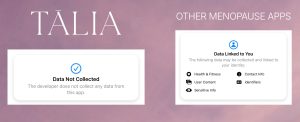
We could have taken investment. But we understood quickly that the value investors would see wasn’t in the tool — it was in the data behind it. Women’s personal health data. And that wasn’t a trade-off we were prepared to make.
So we bootstrapped. We self-funded the whole thing, kept full control of the product and its principles, and built TALIA from the ground up as a privacy-first tool. What you put in stays on your device. It doesn’t live in a cloud. It can’t be converted into a data asset.
TALIA isn’t a life sciences company backed by millions. It’s two people who believed women deserved something better — and built it without compromising to get there. This means we don’t have the marketing budgets that most apps rely on to grow and awareness will need to be organic through people sharing something useful with those they care about.
How to Help Someone You Think Might Have Perimenopause
If you’re a woman who recognises this story — in yourself or in someone you care about — you already know what it means to have someone hand you a piece of the puzzle at the right moment. If someone came to mind while you were reading, that instinct is worth following. You can share TALIA and give them a free month to try it. Just something that might help, passed on.
If you’re a partner — and you’ve watched someone you love change in ways that are hard to explain, and felt the helplessness of not knowing what to do — here’s something practical and genuinely useful you can do. Not a fix. But a way of saying: I’ve been paying attention, and I found something that might make things a little easier. Share the link. Let her decide what to do with it.
Go to our Pass It On page and use the link to download if it is for yourself or choose either the phone or desktop link in the header and share with someone who could benefit from a month free.
Common questions about recognising perimenopause
Why is perimenopause so often missed?
Perimenopause is frequently missed because its symptoms — anxiety, low mood, poor sleep, brain fog and palpitations — are easily explained away as stress, and many women do not expect it to start in their late 30s or 40s. Even women who know about perimenopause often do not recognise it in themselves until someone points it out.
How can I support a partner going through perimenopause?
Start by understanding what is happening, so you stop taking the changes personally. You cannot fix perimenopause, but you can help her track symptoms, prepare for GP appointments and feel less alone. If you want a starting point, we keep a short list of people and organisations we trust. Sharing a practical tool, rather than offering solutions, is often the most useful thing a partner can do.
Why does recognition of perimenopause often come from friends?
Women who have been through perimenopause often spot it in others before a doctor does, because they recognise the pattern from their own experience. Until it feels personally relevant the information does not always land, but a trusted friend saying ‘this could be hormonal’ is often what prompts a woman to seek help.